Rural residents say they are fed up with crop farms turning into solar farms, bringing noise
BROOKS COUNTY, Ga. (WCTV/Gray News) - Many residents moved to rural Brooks County in southern Georgia for peace, quiet and the red-dirt views of farmland.
But in the last several years, thousands of acres worth of solar farms have taken over peanut and cotton farms, meaning residents now live right next to industry.
Danny Sapp and Peg Howard said they have called Brooks County home for a long time and they said they’re concerned about the changes they’re seeing.
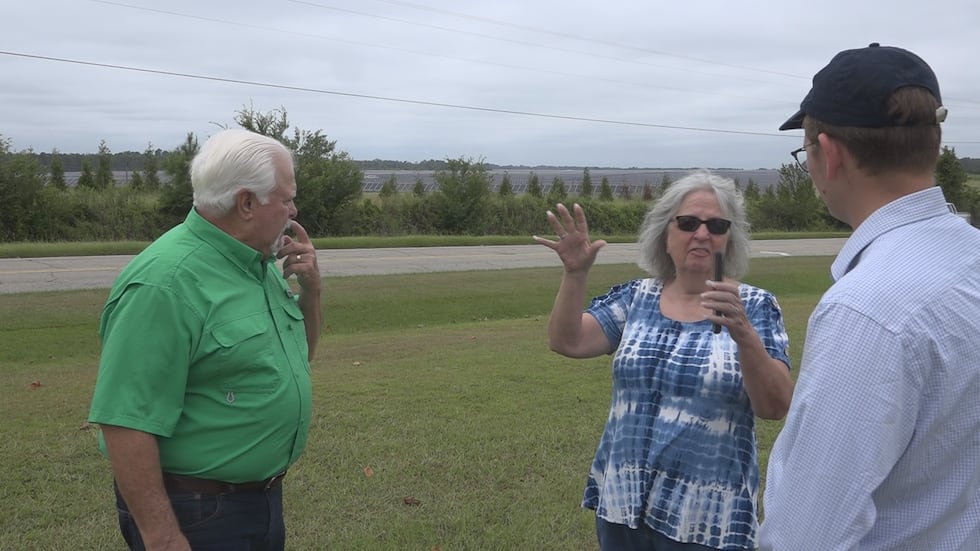
Howard said she wasn’t initially opposed to the solar farms, but after a second project totaling more than 1,700 acres moved in, she’s had enough.
She said solar panels in Brooks County literally stretch as far as the eye can see.
“I just think we need to get to the bottom of this. It’s not about the money, it’s about the humans that are living on the earth,” Howard said.
Sapp and Howard organized a forum with the Brooks County Commission, which took place Thursday.
Brooks County community members say miles of panels changed their rural landscape in the name of energy. Residents said the solar farms are an eyesore, they make an irritating noise, and they take over usable farmland.
“Some of the best farmland [in the state] is here is in Brooks County,” concerned citizen Gwyn Boutwell said Thursday. “And if we use this up for panels, solar panels, if all this farmland is taken in, what are we going to have? What are we going to have to show what we are going to be known for?”
The residents asked the county lawmakers to tighten the ordinance around the solar farms. They want the county to require the farms to be set further back from homes, to require noise mitigation plans, and to require the solar companies to plant trees so residents don’t have to see solar panels next to their front yards.
Sapp said that currently, his backyard faces a peanut farm, but his neighbor has a signed lease option for the solar company to build if the moratorium ends.
NextEra Energy Resources, the company behind that project, said, “Our solar facilities are designed with safety in mind, and we adhere to all applicable local, state and federal regulations when we develop and operate our solar energy projects. We are continuing to work with the county to address the noise concerns that have been raised on our project.”
Some residents argued that it’s a conflict of interest for one commissioner to have a lease option with a solar company while her fellow commissioners are in charge of setting the rules for that company.
While Commissioner Myra Exum’s lease is not with NextEra, she signed it after the company, which is currently operating in Brooks County, was cited for noise violations.
Residents like Howard said they want commissioners to keep an open mind as they bring their concerns forward.
Howard said she hears solar panels in her home from across the street.
“I wish I never had to live through this,” Howard said. “If we have somebody come by, they ask, ‘What’s that noise?’ and unfortunately it affects my health.”
A citation was filed against the field’s owners for noise in the Brooks County magistrate court, the lowest court in the state of Georgia. The owners are supposed to be mitigating it “but that’s been we’re over a year into the mitigation,” Howard said.
The court clerk said that unfortunately, the county inspector died shortly after issuing the citation, so the case has stalled.
She said prosecutors for the county and defense attorneys for NextEra, the solar company, haven’t agreed to solve the case.
According to a 2019 study submitted to the Wisconsin Public Service Commission, most of the noise comes from cooling fans and internal switching circuitry which the study calls a “constant high-pitch tone.”
Sapp said the panels have lowered property values.
“Of course, somebody would buy your property if it’s out and open and has a beautiful landscape, but when you (have) solar panels in your backyard, nobody wants to buy a property. It made mine (have) a lesser value.”
Sapp said most of the land the panels sit on is leased for 30 or 35 years. He said he wonders if the panels will last that long, and if they don’t, who will replace them. He said he worries the panels could just be left in the fields if a solar company goes bust or the panels become obsolete.
“If something happens and they go bankrupt, or the company goes out of business, and they leave and just leave it sitting there, who’s going to clean it up?” Sapp asked.
He also wants to be clear, most of the panels are built on what was recently farmland. Before these thousands of panels, he said crops like cotton, peanuts and soybeans would be grown.
But he said he acknowledges how difficult it would be for a landowner to turn down a lucrative lease because the landowner makes money off the panels without having to till the field.
The issue of solar farms is in some ways pitting neighbor versus neighbor. WCTV obtained unexecuted leases, basically options to lease more farmland, if the moratorium ends. In other words, more panels could be coming.
“You might be sitting at home and thinking, ‘Well, what difference does it make to me since it’s not coming to my yard?’” Sapp said. “But if they keep expanding, then next time, it might be in your backyard.”
Copyright 2024 WCTV via Gray Local Media, Inc. All rights reserved.